Wow Bob

Exorcism, the Alma Mater and the Unspoken Floor

As a college work-study student at Saint Louis University (SLU), my summers were spent doing office work and loan processing for the university’s Financial Aid Department. It was 40 hours a week for minimum wage (plus a tuition credit each semester). There were a dozen or so of us work-study kids in Financial Aid, and we bonded over our shared misery of dealing with mind-numbing paperwork and eccentric Department Staff (our “bosses”). It was straight out of The Office / Office Space / Workaholics (pick your favorite office-ridiculing comedy). That meant finding ways to amuse ourselves to keep from crying.


Now it just so happens SLU is “famous” for being linked to the 1949 exorcism case that inspired The Exorcist movie with Linda Blair.


Jesuits at SLU were involved in performing the actual exorcism (of a teenage boy, not a girl as depicted in the movie) that took place in several locations including the priests’ rectory behind SLU’s College Church. SLU has adamantly denied that the exorcism also took place in DuBourg Hall – a large building that sits adjacent to the College Church and rectory. However, campus-wide rumors persistently labeled the fourth floor of DuBourg Hall as haunted with strange locked rooms where the exorcism (supposedly) was partially carried out. University archivist Randy McGuire contends that what likely occurred was the priests could hear the exorcised boy screaming from their offices on the fourth floor and this linked the exorcism to DuBourg Hall.

DuBourg Hall adjacent to the College Church.


Well it also just so happens that SLU’s Financial Aid office was on the second floor of DuBourg Hall, and the office generated a lot of paperwork. While records were kept electronically, every student file had a hard copy backup. With space in the office limited, inactive student files were occasionally re-located to storage. It was generally expected that the college work-study students would take on the responsibility of re-locating no longer needed files, broken furniture, old cabinets, etc. to storage as part of their duties. And, as you probably guessed already, storage was located on the fourth floor of DuBourg.

Moving files meant gaining access to the keys to the fourth floor, loading up whatever was to be moved on a dolly, taking the world’s oldest freight elevator up a few floors and basking in the freedom of being away from our desks. We were the world’s most educated moving crew, and as many work-study students would “help” with the moves as possible without raising Staff’s suspicions. Basically, we all wanted to escape for awhile. Moving files was considered bona fide fuck-around-at-work time.

The fourth floor was very dark. I believe there was limited or no electrical lighting with natural light coming in primarily from dirty hallway windows. The fourth floor was not temperature controlled so it was hot in the summers and cold in the winters. Every movement echoed. There were lots of old desks, filing cabinets and furniture in common areas and a long hallway of locked doors. The hallway had random debris in it. Doors we managed to open revealed rooms that appeared to have been hit by an earthquake with contents scattered around haphazardly. It felt like stepping back in time to a decrepit, abandoned high school. Definitely creepy, no doubt about it.

There were a series of doors and a series of locks to reach the room that housed the Financial Aid files. The room was much larger than was needed for our storage needs, and it was here that we played paperwad baseball and wiffle ball for as long as we dared after dumping the files off in the room. Paperwad baseball was fun, but did get boring after awhile. That left exploring the floor as the next best activity. And here’s the thing:

It was the fourth floor that was notorious for being haunted and for the exorcism, but then we discovered the fifth floor.

Now technically this may be semantics, because the only way to access the fifth floor is via the fourth floor. The entrance appears as a normal door to a locked closet or room, but behind the door to our surprise was a very narrow and extremely steep, rising staircase.


Oh boy, we were excited and freaked out! Of course, we had to find out what was up these stairs. Now the extensive research that went into this Fort Bachmann exclusive revealed many internet references to the fourth floor. One caught our attention. It was a comment regarding a very lame YouTube Video about the fourth floor. This commenter stated:  “…i used to go up there all the time in [2003] before they redid it- there is still padding on the effing walls and demonic writings on a chalkboard. There were also strange cages for who knows what and newspapers on the floor from the 1940’s.” We think this person is speaking about the fifth floor because what we saw somewhat maps to this description.

What we found was a “mini-floor” like they tried to cram a bunch of rooms up in a slanted attic space. There were very dated newspapers on the floor. I remember feeling a draft with a sense of city air – like some place in the rafters was exposed to the outside. I don’t recall demonic writings, but random writings for sure. We were able to deduce that the floors tiny windows near the ceiling were facing Grand Ave and that they were the triangular ones on the roof as indicated in this screenshot:

DuBourg Hall rooftop windows.


The room contents were chaotic and one of the rooms was marked as 505!


And then there were the creepy cages – like jail cells. What was going on here?


We visited the fifth floor only a few times to show other work-study students. I now wish we would have taken more photographs. This was back in the early 1990’s. We have not returned to the interior of DuBourg Hall since graduation. In 2007, the fourth floor of DuBourg was remodeled. A YouTube video shows public elevator access to a remodeled fourth floor.


But the question remains:

What happened to the unspoken fifth floor?

Was it sealed off and left untouched with secrets to the exorcism buried within its creepy cages?

I guess we will never know.

the greatest rumble ever?


Boats and Barges from the Bachmanns’ Balcony

Say that three times fast, then watch our slideshow-video of what’s been floating by the past 7 months. A view of the East River and Manhattan from 13 stories up. Cameos by Roman and Boppy.

The video will play right from the page, but for a larger view, go directly to the YouTube post here.


The Now Legendary Ankle Bracelet

On July 19th, 1989 – the day before my mom gave birth to my youngest sibling, Todd – I put a cloth friendship bracelet around my right ankle. The bracelet was meant to serve as a token of good luck for Todd’s arrival. My mom had complications with this pregnancy and Todd’s birth was a planned event with labor induced before he was full term. I vowed to remain wearing the ankle bracelet until my preemie brother was well out of any health danger.


The birth went smoothly and soon Todd came home from the hospital to join his other 5 siblings. He continued to gain weight and get stronger. Before I knew it, a day turned into a week turned into a month. He was doing well and so I didn’t want to jinx it by removing the bracelet. Time continued to pass…6 months…a year…two years…Todd was growing up and the bracelet remained around my ankle 24/7/365.


Because he continued to be healthy, I continued to wear the bracelet, without thinking much about it.


We are now approaching 24 years and the ankle bracelet lives on. Todd will be getting married a few days before his birthday in July 2013. I plan to attend, ankle bracelet in full effect.

The knot is worn and the bracelet is heavily frayed after 24 years. I blurred out the leg hair. You’re welcome.


The typical reactions to the bracelet craziness:

(1) wow, that is unbelievable,

(1a) wow, that is gross,

(2) where did you get it from,

(2a) what is that thing made of


My typical responses to these reactions:

(1) yeah, I can’t believe it has lasted this long,

(1a) I shower (a lot),

(2) I got the bracelet from a vending machine,

(2a) it’s made out of some nylon-type of material


The bracelet was purchased from a typical coin-operated trinket machine at the now-defunct Omni Sports.


Prior to the birth of my son Tristan in 2011 (also a planned event after my wife’s pregnancy had complications), Todd reciprocated by putting on a cloth ankle bracelet as a good luck charm for Tristan. Tristan spent 10 days in the NICU, but did very well and has been extremely healthy. Not that we can point to Todd’s ankle bracelet as the reason because it has come to my attention that it fell off his leg and was lost not long after it was put on. Todd claims it was his inability to make a decent bracelet (instead of buying a pre-made bracelet, he made his own). Maybe I should remove mine and jinx Todd as retribution.


Nah.


WIBL aka Ping Pong Baseball

The World Indoor Baseball League (W.I.B.L., or simply WIBL – rhymes with dribble, also known as Ping Pong Baseball) of the late-1980s pitted me against my brother Tim in a baseball-like game played exclusively in the unfinished basement of our family’s suburban St. Louis home, converting table tennis equipment into a competitive, pseudo-wiffle-ball-type of contest. We played generally during the baseball season with concentrated periods over the summer (evenings after the sun went down or during the middle of the day when the summer temps were just too hot for outside athletics).

WIBL was one-on-one baseball with bases, walks, K’s, homers, etc., but the baseball was a ping pong ball, the bat was a ping pong paddle, the backstop was the folded up ping pong table. A laundry basket was placed on a folding chair and set on its side to serve as the strike zone (see below). The basement was fairly large and generally uncluttered so our field of play was a decent size.

A modern-day imitation of the laundry basket on a chair we used to create a strike zone. Home plate would be centered in front of it.


The beauty of the game was really in the pitching. A ping pong ball can be thrown at high velocity with less than typical exertion and most notably can be made to curve and tail in ways far more extreme than a wiffle ball. Throwing the ball like a knuckle ball would create a ceiling scraping trajectory that would then rapidly descend by several feet to cross the plate as a strike. The laundry basket also made for a generous strike zone. This didn’t mean there wasn’t offense, because the paddles provided a wide area to make contact with the ball. It just meant that it was more of a balanced game than others.

First timers usually swung the paddle one handed, but soon found it to be more comfortable to actually mimic swinging a bat with two hands. We used our little league, too-small-for-real-baseball gloves on defense to catch line drives headed for the home run wall. A home run was a line drive that traveled the length of the basement and hit the back wall at a certain height above a line masking-taped onto the wall. As this was indoors, a line drive could ricochet off a side wall, hit the back wall and still be a home run. A line drive that hit the back wall, but was caught on the rebound before hitting the ground was an out.

Between video games, junk food and actual outdoor activities, WIBL kept us entertained for hours on end. Occasionally we played two-on-two with friends.

Some classic memories: the loud smack of the ping pong ball hit against the furnace (an automatic foul ball even though the furnace was in fair territory), hitting a ball towards or under the downstairs steps (usually meant extra bases), ping pong balls cracking (they wore down under the abuse just like wiffle balls), elbow pain from playing/throwing so much, taping paddle handles that cracked from dropping the paddles to run the bases, never actually playing ping pong.

As with any historic ballpark, there were some quirks that defined the field of play:


A small trashcan served as first base. To get an out at first, a fielded ball was thrown at the trashcan and must hit it anywhere, on a fly or bounce, or hit the runner before he touched/kicked/slide into the trashcan. Once safely on first, or any other base, ghost runners were implemented.


Second and third base, home plate and pitching rubbers were simply tape marks on the floor. Pictured: duct tape remnants from a rectangular third base, photographed in 2012.


HVAC duct that ran along the basement ceiling was taped to indicate how far a fly ball that hit the ceiling/duct needed to travel to be considered fair.


More tape marks on the HVAC duct served as a creative extension to the foul pole (the electrical line to the left of the fridge). The wall behind the fridge is the home run wall. The wall wasn’t white until 2012.


As I was involved, there of course had to be stats. We taped a piece of graph paper to the ping pong table backstop and would fill in K’s and Homers after each inning:


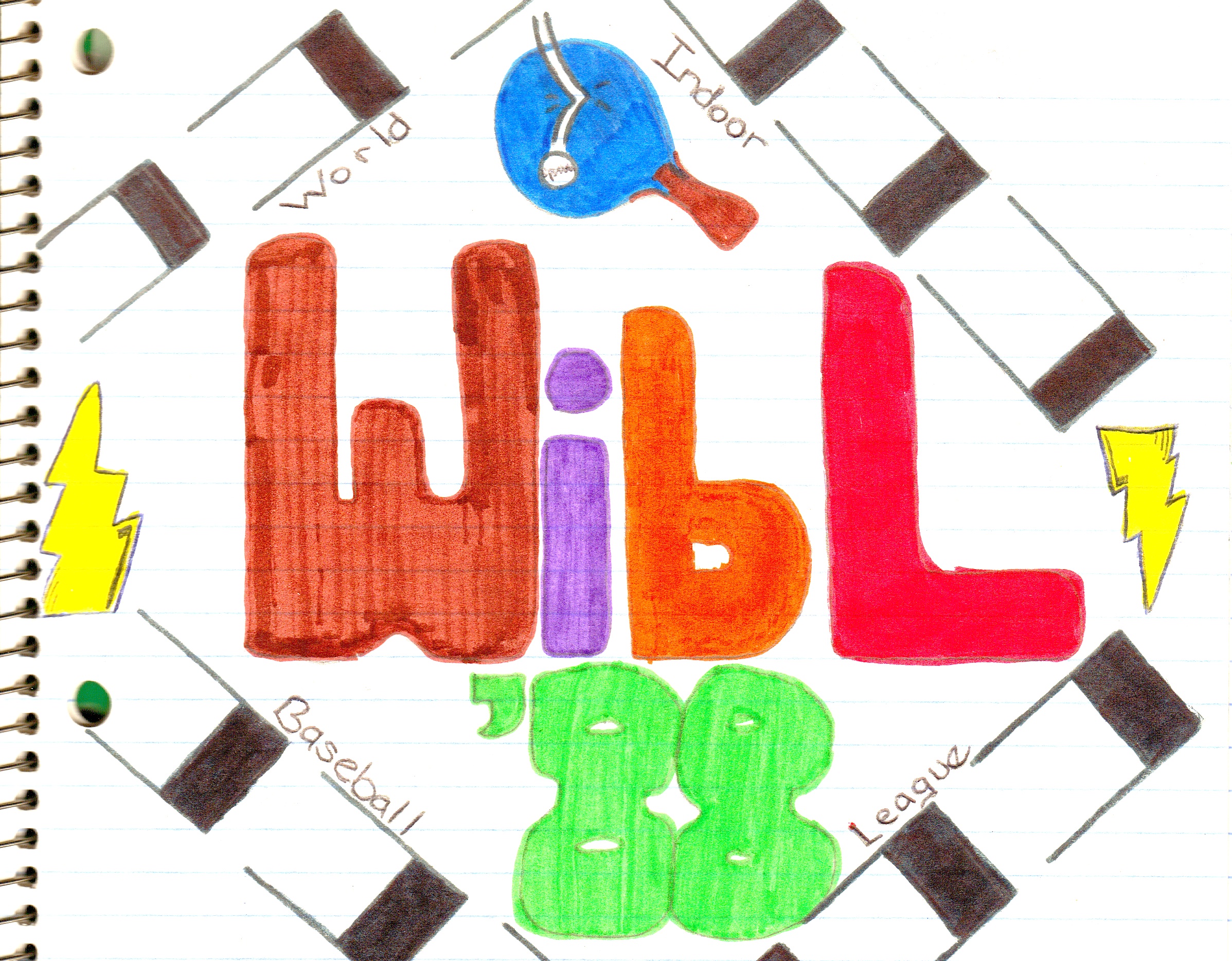
If there were stats, then there just had to be a compilation, which resulted in the WIBL statbook that covered Ping Pong Baseball in its prime (the 1988 and 1989 seasons). My penchant for branding was alive even as a kid as everything seemed to have some sort of logo:

The WIBL statbook was your basic college-ruled notebook paper containing a wealth of hand-summarized stats, charts and other minutia.


Loved graph paper and angular letterforms. Still do. So used it for a StartUp Series logo (nice ping pong guy!). We made up several special contests like the Startup Series throughout the year.


The Survivor Series was our all-star break contest – too complicated to describe here, but worthy of its own post in the future. It was classic Bachmann.


A page break in the WIBL statbook indicating the ’89 section. More angular letters.


Sportcraft ping pong balls lasted longer than generics. Made them the corporate sponsor of our World Series event. Hysterical!


Homering off the Jackpot sign earned you money. Nerds!


So much good stuff in the WIBL statbook. As I was the older brother, I tended to win a majority of the games. So we came up with a point system that acknowledged successes other than just wins. This helped even the playing field, although Tim did just fine as indicated by the Updated WIBL Records after the ’89 season:


And so, if that wasn’t enough, I’ll leave you with the pitches each player had in his arsenal for the ’89 season as documented on page 22 of the WIBL statbook.

Matt:  Fastball, Curveball, Change, Knuckleball, Twist-a-knuckle
Tim:   Fastball, 2 Curves, Change, Reuschelball (ode to Rick Reuschel?), Knuckleball